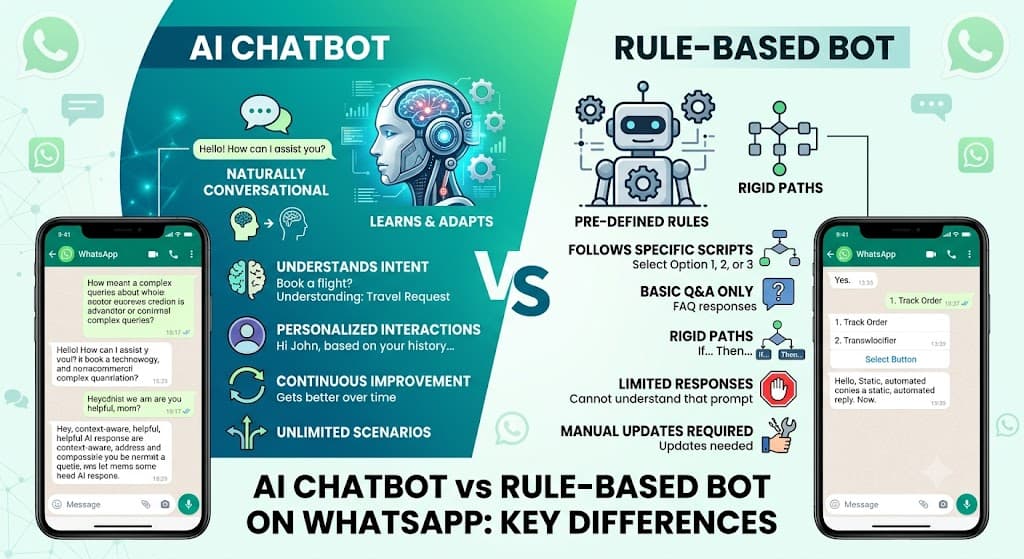
Every WhatsApp automation platform will tell you their bot is "AI-powered" — it's become a default marketing phrase rather than a meaningful description. But underneath the label, there are really only two fundamentally different approaches, and understanding the difference matters more than most businesses realize before they commit to a platform.
What a Rule-Based Bot Actually Is
A rule-based bot follows a fixed decision tree. When a customer sends a message, the bot checks it against a list of predefined triggers — specific keywords, button taps, or menu selections — and responds with a pre-written answer. There's no real "understanding" happening; it's pattern matching.
This sounds basic, but it's not a weakness in every context. For predictable, repetitive interactions — booking a slot, checking order status, choosing from a menu — rule-based flows are fast, 100% consistent, and impossible to "confuse" because there's no ambiguity to misinterpret.
What an AI Chatbot Actually Is
An AI-powered bot, built on a language model, reads the actual meaning of a message rather than matching keywords. It can handle a customer who types "is this cheaper than the other one you have in blue" — a sentence no rule-based system could realistically anticipate — and respond with a genuinely relevant answer based on real product context.
"The mistake most businesses make isn't choosing the wrong type of bot — it's assuming they have to choose only one."
Side-by-Side Comparison
| Factor | Rule-Based Bot | AI Chatbot |
|---|---|---|
| Best for | Bookings, order status, fixed menus | Open-ended questions, objections, comparisons |
| Consistency | 100% predictable every time | Generally consistent, occasional variation in phrasing |
| Setup effort | Manual flow-building for every scenario | Trained once on business context, adapts naturally |
| Handles unexpected input | Poorly — breaks or gives a generic fallback | Well — responds contextually |
| Cost to run | Lower, no per-message AI processing cost | Slightly higher, but often negligible at typical SMB volume |
Where Rule-Based Bots Fall Short
The core problem shows up the moment a real customer deviates even slightly from the expected script. Someone types "kal available hoga kya" instead of tapping the "Check Availability" button, and a purely rule-based bot either ignores it, gives an unrelated canned reply, or dead-ends the conversation entirely — at exactly the moment a human would have just answered the question.
This is where businesses lose sales without realizing it. The customer doesn't complain; they just stop replying and message a competitor instead.
Where Pure AI Chatbots Fall Short
AI isn't a universal fix either. For truly repetitive, high-volume actions — like collecting a delivery address or confirming an order — a structured button flow is genuinely faster and less error-prone than typing everything in natural language. AI can also occasionally produce a response that's technically reasonable but not what your specific business policy allows, if it isn't properly grounded in your actual rules.
Practical example: A customer asking "can I get a refund" needs an AI system that knows your actual refund policy — not a generically "helpful" answer that promises something your business doesn't actually offer.
Why the Hybrid Approach Wins in Practice
The most effective WhatsApp automation systems don't force a choice — they use structured flows for the predictable 60-70% of interactions, and let AI take over the moment a conversation goes off-script. This is the architecture behind ConviDesk AI: a deterministic flow engine (getReply()) handles known patterns instantly, and an AI fallback layer, grounded in your specific business's product and policy data, steps in for everything else.
The result is a bot that feels reliable for simple tasks and genuinely helpful for complex ones — without the rigidity of pure rules or the unpredictability of pure AI.
How to Evaluate a Platform's Claims
When a WhatsApp automation platform says it's "AI-powered," ask specifically:
- Does the AI have access to my actual product catalog and business policies, or is it answering generically?
- What happens when the AI isn't confident in an answer — does it hand off cleanly, or guess?
- Are structured flows available for the repetitive parts of my business, or is everything routed through AI regardless of complexity?
A platform that can answer all three clearly is genuinely built for hybrid use. One that can't is likely using "AI" as a marketing label rather than a real architectural choice.
Bottom Line
Don't ask "should I use a rule-based bot or an AI chatbot." Ask "which parts of my customer conversations are predictable, and which parts genuinely need understanding." The answer is almost always both — and the platforms built around that reality are the ones that actually convert more of your WhatsApp traffic into paying customers.