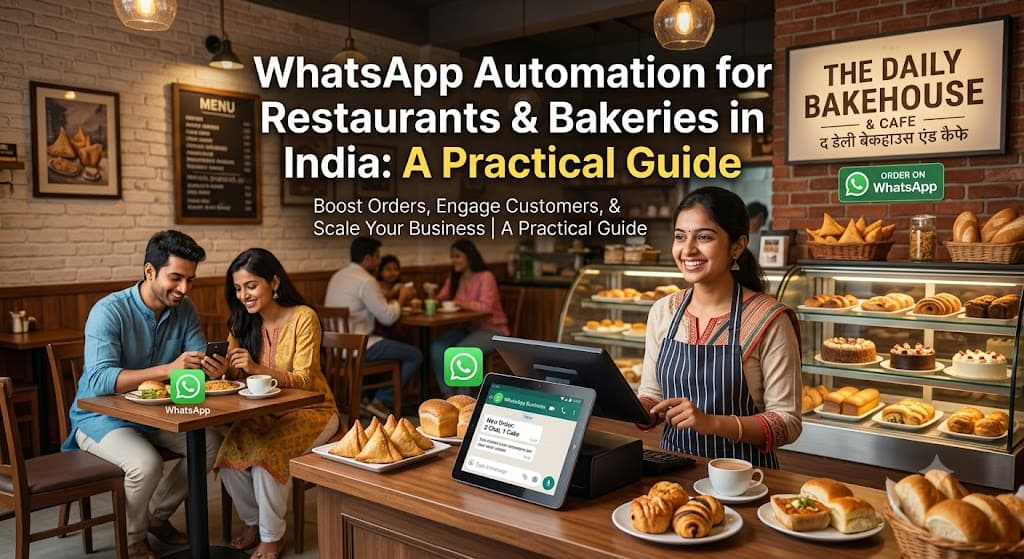
If you run a restaurant, bakery, or cloud kitchen in India, chances are your busiest hour on WhatsApp isn't during business hours at all — it's late evening, when someone scrolling Instagram sees a cake or a dish they like and messages you directly to ask "price kya hai" or "available hai kya abhi."
This is one of the most common and most poorly handled moments in a food business. The message sits unread for hours. By the time someone replies, the customer has often already ordered from a competitor who responded faster.
This guide looks at exactly how automation fits into a food business — what to automate, what to keep human, and how businesses like bakeries and restaurants are actually using it in India right now.
Why Food Businesses Are a Perfect Fit for WhatsApp Automation
Unlike many other business categories, food businesses tend to get a very repetitive set of questions:
- "Is [item] available today?"
- "What's the price for [item]?"
- "Do you deliver to [area]?"
- "Can I customize this order?"
- "What time do you close?"
These questions are highly predictable, which makes them ideal for structured automation — a menu-driven flow can answer most of them instantly, any time of day, without a human needing to type the same answer for the hundredth time.
The Instagram-to-WhatsApp Pipeline
For most food businesses in India, especially bakeries and home-based kitchens, Instagram is where discovery happens and WhatsApp is where the sale closes. Someone sees a reel of a cake being cut, taps the profile, and messages "yeh cake kaise order karu."
"The businesses that convert Instagram followers into paying customers aren't necessarily the ones with the most followers — they're the ones who reply to that first WhatsApp message fastest."
This is exactly where automation earns its keep. An AI-powered auto-reply can immediately acknowledge the message, ask which item they saw, share pricing and available flavors or sizes, and guide them toward placing the order — all before a human even opens the chat.
What to Automate vs What to Keep Human
Not everything should be automated, and knowing the line is what separates a helpful bot from an annoying one.
| Automate | Keep human |
|---|---|
| Menu and pricing questions | Custom cake design requests |
| Delivery area and timing | Complaints or order issues |
| Order confirmation messages | Bulk/catering negotiations |
| Repeat order reminders | Sensitive customer feedback |
Rule of thumb: Automate anything that's the same answer every time. Keep a human in the loop for anything involving judgment, negotiation, or a customer who sounds frustrated.
A Typical Automated Flow for a Bakery
Here's what a well-built flow looks like in practice, combining structured menus with AI fallback for anything unexpected:
- Customer messages "Hi" or asks about a specific item
- Bot greets them and shows a button menu: View Menu / Track Order / Talk to Us
- If they tap "View Menu," a categorized list appears — cakes, pastries, breads — with prices
- If they ask something outside the menu ("kya aap eggless cakes bhi banate ho?"), AI steps in with a natural, accurate answer based on the business's actual offerings
- Once they're ready to order, the flow collects delivery details and confirms the order automatically
This entire sequence can happen in under two minutes, at any hour, without anyone on the business side lifting a finger — until it's time to actually bake and deliver.
Handling Festival and Weekend Rushes
Food businesses in India see massive spikes around festivals — Diwali, Eid, Christmas, birthdays and wedding seasons. This is exactly when manual response times break down the most, because message volume can jump 5-10x overnight.
Automation doesn't just help during rushes — it becomes essential. A bakery that can only reply to 30 messages a day manually might receive 300 messages during a festival weekend. Without automation, the vast majority of those go unanswered, and unanswered messages rarely convert.
Broadcast Messaging — Use It Carefully
Many food businesses want to send a broadcast the day before a festival: "Diwali special sweets available now, order today!" This works, but has real rules attached:
- Customers must have opted in to receive messages from your business
- Broadcasts fall under Meta's "marketing" conversation category, which carries a per-conversation charge
- Overusing broadcasts (multiple per week) tends to increase opt-outs and can hurt your sender reputation with Meta
A good practice is limiting broadcasts to genuinely important moments — a new menu launch, a festival special, a limited-time offer — rather than routine promotion.
What Real Results Look Like
For food businesses combining Instagram discovery with automated WhatsApp replies, the common pattern is straightforward: faster first-response times lead directly to higher conversion from casual "just asking" messages into confirmed orders. When every inbound message gets an instant, accurate reply instead of sitting for hours, fewer potential customers drift off to a competitor in the meantime.
Getting Started
If you're running a bakery, restaurant, or food business and still handling WhatsApp manually, the highest-leverage first step is simple: set up an instant auto-reply with your menu and pricing, even before adding anything more advanced. That alone captures the customers who would otherwise give up waiting for a reply.
ConviDesk AI is built specifically with this kind of use case in mind — structured menus for the predictable questions, AI fallback for everything else, and a product catalog that keeps your pricing and availability always up to date without manual editing.